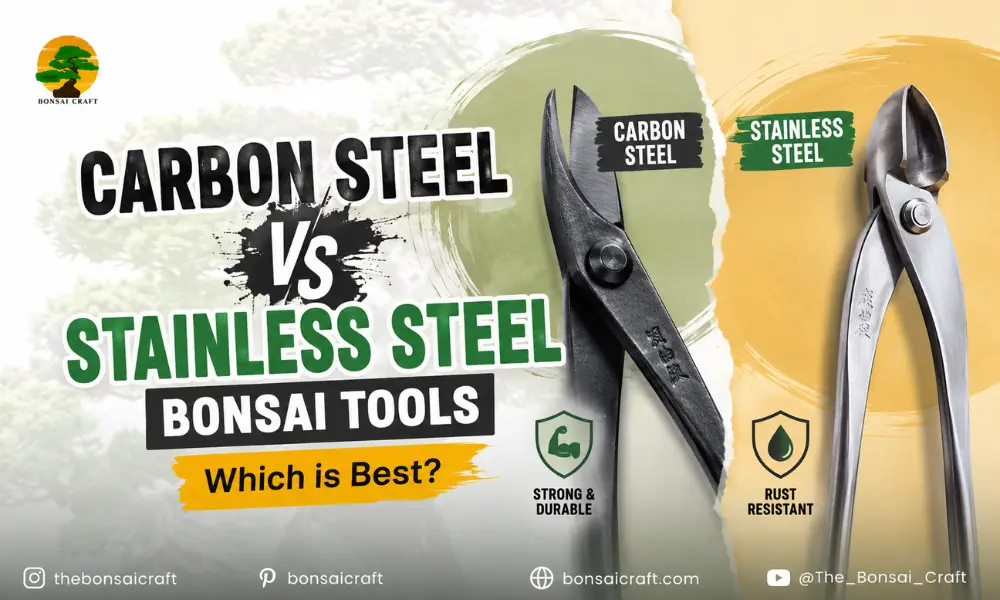
The carbon steel vs stainless steel debate is one of the most common questions new and intermediate bonsai practitioners face when building their first tool kit. Both materials are used widely across the bonsai world, and both carry genuine strengths. The answer is not simply about which is better overall. It is about which suits your climate, your working habits, and the specific tasks each tool is meant to perform.
Carbon steel is an iron and carbon alloy, with carbon content ranging from 0.05 percent in mild grades up to 2.1 percent in high-carbon versions. Stainless steel must contain at least 10.5 percent chromium by mass, which forms a self-repairing oxide layer that resists rust. The tradeoff is that stainless steel production requires deliberately keeping carbon content low, and that directly shapes how the cutting edge behaves. Understanding this relationship is the starting point for choosing wisely.
What Is Carbon Steel vs Stainless Steel: The Core Difference
The fundamental difference between carbon steel and stainless steel comes down to chromium content: stainless steel must contain at least 10.5 percent chromium to achieve corrosion resistance, while carbon steel contains very little chromium and derives its character almost entirely from its carbon content.
For bonsai tools, carbon steel should always mean high-carbon steel, above 0.6 percent carbon content. Low-carbon or mild steel is too soft to hold a useful cutting edge and is not worth purchasing at any price. In the Japanese tool market, refined grades like white steel (Shirogami) at 0.80 to 0.90 percent carbon and blue steel (Aogami), which adds chromium and tungsten for improved durability, represent the benchmark for serious bonsai cutting instruments. Both reach 60 HRC and above when properly heat-treated.
Stainless steel achieves rust resistance through its chromium layer, which reforms automatically when scratched. Carbon content in most stainless steel is kept below 0.1 percent to prevent chromium carbide formation during manufacturing, which would rob the material of the very property it is valued for. This is why hardness and sharpness in stainless tools vary so widely across brands. If you are just getting started and want to understand which tools belong in a beginner kit, the Bonsai Craft guide to bonsai tools for beginners covers the full essentials before you spend a dollar.
Carbon Steel vs Stainless Steel: Which Is Stronger?
High-carbon steel achieves greater hardness and sharper edge retention than most stainless steel tools, but stainless steel is generally tougher and less prone to fracturing under heavy lateral stress.
Hardness is measured on the Rockwell C scale (HRC). Quality carbon steel bonsai tools typically reach 60 to 65 HRC when properly heat-treated. Most mid-range stainless bonsai tools fall between 52 and 58 HRC, with premium stainless reaching 55 to 60 HRC. Research by the Cutlery and Allied Trades Research Association (CATRA) in Sheffield found that at an equivalent hardness of 61 HRC, stainless steel showed slightly superior cutting performance over carbon steel. The key phrase is equivalent hardness. In the real bonsai tool market, carbon steel instruments are more consistently heat-treated to higher hardness levels than stainless products at the same price point, giving carbon steel a practical cutting advantage in most comparisons.
Stainless steel is less brittle, which matters during tasks involving lateral force, heavy root cutting, or knob work. Carbon steel tools tend to bend before they fracture, while stainless can snap cleanly under the same abuse. Neither material is indestructible.
When to Use Carbon Steel vs Stainless Steel
Carbon steel is the better choice for precision pruning and styling work, while stainless steel is the smarter option for wet environments, root work, and practitioners who prefer lower maintenance demands.
If you are doing refined branch pruning, working on fine deciduous ramification, or styling conifers where each wound matters, carbon steel scissors and concave cutters deliver cleaner cuts. A sharper blade parts live tissue without crushing cells, which leads to faster healing and less dieback. Good pruning technique starts with good tools, and the step-by-step bonsai trimming guide at Bonsai Craft explains in detail how cut quality directly affects tree recovery.
If you live in a humid or coastal climate, work through wet seasons, or you are a beginner still developing your post-session routine, stainless steel gives you an important safety margin. Unprotected carbon steel tools can develop surface rust within 24 hours in humid conditions, as documented in practical testing by bonsai supplier Bonsai-En. Stainless tools forgive a damp storage bag or a rushed cleanup in a way that carbon steel simply does not. Beginners building their first toolkit will find a reliable starting point in the Bonsai Craft bonsai starter kit guide, which includes tool recommendations alongside tree and soil choices.
For root work and repotting specifically, many practitioners who prefer carbon steel for branch cutting reach for stainless tools instead. Wet soil contains moisture, mineral particles, and organic acids that all accelerate corrosion on carbon steel. Stainless handles that environment with far less complaint.
Edge Retention and Sharpness: Where Carbon Still Leads
Carbon steel holds a sharper initial edge and is significantly easier to restore on a whetstone than stainless steel, making it the preferred cutting material among experienced practitioners who sharpen their tools regularly.
High-carbon steel achieves a fine-grained microstructure that allows honing to a very acute angle without the edge rolling under cutting pressure. The result is a blade that slices rather than compresses, which matters directly for tree health. Cleaner cuts callus over more predictably and reduce the risk of dieback at the wound margin. This is one reason that maintaining sharp tools is treated as a core part of responsible bonsai care, not just a maintenance preference.
Sharpening carbon steel takes less effort than stainless. A dual-grit whetstone restores a carbon steel blade to working sharpness in minutes. Stainless steel resists the stone more firmly because chromium increases abrasion resistance alongside corrosion resistance. Diamond plates are not recommended for fine bonsai blades as they remove metal too aggressively and can damage the temper. Over a full growing season, the difference in sharpening effort between the two materials is genuinely noticeable.
Maintenance: What Each Material Demands
Carbon steel requires oiling after every use to prevent rust, while stainless steel tolerates more forgiveness in day-to-day care but is not entirely maintenance-free.
For carbon steel tools, the routine is straightforward: wipe blades clean of sap and debris after each session, dry thoroughly, then apply a thin coat of camellia oil before storage. Camellia oil, derived from camellia plant seeds and used traditionally in Japan to protect samurai swords and fine cutting tools, bonds with steel molecules to form a stable anti-rust barrier. Its neutral pH and low viscosity make it ideal for bonsai tools. Choji oil is an equally effective traditional alternative. Applied consistently after every session, either oil keeps carbon steel tools in excellent condition indefinitely.
Stainless steel tools benefit from the same cleaning routine but the penalty for skipping oil is far less immediate. A stainless tool wiped down and stored without oil will not develop significant rust overnight. Both materials need attention at pivot points, where sap and grit accumulate and bind the hinge over time. One drop of oil at the joint after cleaning keeps any tool moving freely. The full principles of consistent bonsai tree care, including how tool condition ties directly into tree health, are covered in the Bonsai Craft bonsai care guide.
Cost and Brand Considerations
Carbon steel bonsai tools are generally less expensive than comparable stainless steel tools, though premium Japanese carbon steel instruments can match or exceed the price of mid-range stainless options from lesser-known brands.
The cost gap comes from material composition and manufacturing precision. Stainless steel requires chromium, nickel, and often molybdenum, and achieving strong cutting performance in stainless demands carefully controlled heat treatment. Both factors add to the retail price. Budget carbon steel tools made from low-carbon steel will never hold a proper edge. Cheap stainless tools hardened to only 50 HRC will frustrate every sharpening attempt. For both materials, buying from a manufacturer who documents steel grade and hardness is more important than the price alone.
Brands like Kikuwa, produced in Sanjo City, Niigata Prefecture, and Ryuga both offer tools in carbon and stainless steel at different price points. One well-made tool outperforms a full set of poorly made alternatives in every situation that matters.
FAQ
What is the main difference between carbon steel and stainless steel bonsai tools?
Carbon steel offers superior sharpness and edge retention, while stainless steel resists rust and corrosion far better. Carbon steel reaches higher hardness through its carbon content, producing a finer and easier-to-restore cutting edge. Stainless steel uses at least 10.5 percent chromium to form a corrosion-resistant surface layer. For bonsai work, carbon steel cuts more precisely but demands consistent oiling, while stainless is more forgiving across daily use and humid conditions.
Is carbon steel stronger than stainless steel for bonsai cutting tasks?
High-carbon steel is harder and holds a sharper edge, but stainless steel is tougher and resists fracturing better under heavy stress. At equivalent hardness levels both perform similarly, but premium carbon steel tools are typically heat treated to higher HRC values than comparable stainless tools at similar price points, giving carbon steel a consistent practical cutting advantage in real-world bonsai use.
When should I use carbon steel vs stainless steel bonsai tools?
Use carbon steel for precision pruning and styling where wound quality directly affects tree recovery. Use stainless steel during root work, repotting, wet-season gardening, or in consistently humid climates where managing rust on carbon steel would become a daily burden. Many experienced practitioners use carbon steel for primary cutting tools and stainless steel for root cutters and any tools that regularly contact wet soil.
How do I stop carbon steel bonsai tools from rusting?
Apply a thin coat of camellia oil to all metal surfaces after every use, including pivot points. Wipe tools clean of sap first, dry completely, then oil before storage. Practical testing has shown unprotected carbon steel tools develop surface rust within 24 hours in humid conditions, while oiled tools stay clean. Silica gel packets stored in your tool roll add extra protection against condensation during storage between sessions.
Are stainless steel bonsai tools worth the higher price?
Stainless steel tools justify their cost when reduced maintenance genuinely matters to you or when your climate makes consistent carbon steel care impractical. In dry climates with regular upkeep, quality carbon steel often delivers better cutting performance at lower cost. For beginners, humid-climate gardeners, and practitioners who want a reliable low-maintenance kit, stainless steel’s price premium reflects a real reduction in rust risk and long-term replacement cost.
Final Thoughts
Carbon steel vs stainless steel is not a question with one correct answer for every practitioner. Carbon steel, properly maintained with camellia oil after each session, delivers cutting performance that stainless tools at the same price point rarely match. Stainless steel, in well-made form, offers a maintenance buffer that is genuinely valuable in humid climates and for anyone still building their tool care habits. The most practical approach for experienced enthusiasts is a mixed kit: carbon steel where precision matters most, stainless where moisture and convenience take priority. Whatever direction you choose, buy from makers who can tell you what their steel actually is. Tools worth owning are tools worth understanding.